China’s Linglong One SMR: A Strategic Signal for Indonesia’s Energy Future
Strategic Foresight – Chairman’s Brief
Executive Summary
China is approaching commercial operation of Linglong One (ACP100), the world’s first land-based commercial Small Modular Reactor (SMR) based on pressurized water reactor technology. While its electrical output of 125 MW is modest compared with conventional nuclear plants, the project’s strategic importance lies elsewhere.
Linglong One represents a potential shift from bespoke nuclear construction toward industrialized energy manufacturing. If proven commercially successful, SMRs could transform nuclear energy from a decade-long megaproject into a standardized infrastructure product manufactured in factories and deployed at scale.
The implications extend far beyond electricity generation. SMRs could become foundational infrastructure supporting AI-driven economies, advanced manufacturing, mineral downstreaming, industrial parks, data centers, and national energy resilience.
For Indonesia, the strategic issue is not whether to adopt a specific Chinese reactor design today. The more important question is whether Indonesia is adequately preparing its regulatory framework, industrial ecosystem, financing mechanisms, and human capital to participate in a future SMR-driven energy landscape.
Why This Matters
Historically, nuclear power has faced four structural barriers:
- High capital expenditure
- Long construction periods
- Project execution risks
- Public acceptance challenges
Traditional nuclear plants typically require:
| Conventional Nuclear | Typical Range |
|---|---|
| Capacity | 1,000–1,600 MW |
| Construction Period | 8–15 years |
| Capital Cost | US$10–30 billion |
| Delivery Model | Site-built, custom engineered |
Linglong One seeks to change this paradigm through:
- Factory fabrication
- Modular construction
- Standardized design
- Repeatable deployment
- Reduced construction timelines
- Smaller financing requirements
The strategic analogy is not another power plant. It is containerization.
Containerization did not merely improve shipping efficiency; it fundamentally transformed global trade. Likewise, commercially successful SMRs could fundamentally transform how countries deploy clean and reliable electricity infrastructure.
Strategic Relevance for Indonesia
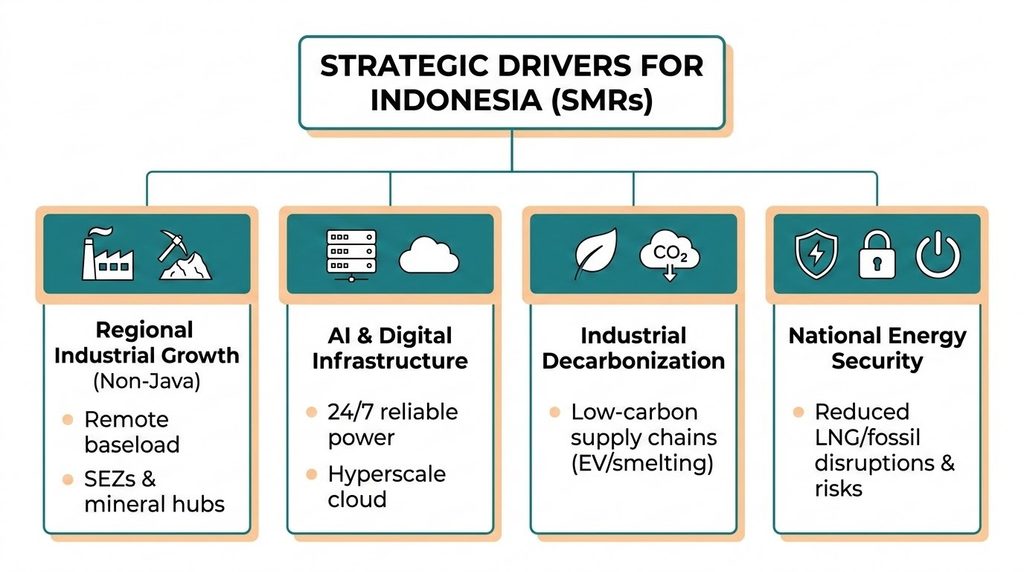
1. Enabling Industrial Growth Beyond Java
Indonesia’s economic future increasingly depends on industrial clusters outside traditional demand centers.
Potential future applications include:
- Nickel and battery ecosystems in Sulawesi
- Copper and mineral processing hubs in eastern Indonesia
- Special Economic Zones (SEZs)
- New industrial corridors
- Future AI and cloud-computing campuses
Many of these locations face limitations in grid reliability, transmission capacity, fuel logistics, and energy affordability. SMRs could potentially provide localized baseload power without requiring massive transmission investments.
⸻
2. Supporting AI and Digital Infrastructure
The emergence of artificial intelligence is creating unprecedented demand for electricity. Globally, hyperscale data centers increasingly require 24/7 reliable power, high-quality grid stability, low-carbon electricity, and long-term energy price certainty.
Unlike solar and wind resources, nuclear power delivers continuous generation regardless of weather conditions. As Indonesia pursues ambitions in AI adoption, sovereign cloud infrastructure, national digital platforms, and advanced semiconductor and electronics manufacturing, long-duration baseload power will become increasingly important.
⸻
3. Accelerating Industrial Decarbonization
Indonesia’s downstream industrial strategy (hilirisasi) relies heavily on energy-intensive processing, spanning EV battery manufacturing, nickel refining, copper smelting, green hydrogen production, and advanced materials processing. However, as global buyers across Europe, North America, and East Asia enforce strict Scope 1 and Scope 2 emissions standards and carbon border adjustments, the carbon intensity of local processing threatens export market access.
Commercially viable Small Modular Reactors (SMRs) offer a transformative dual advantage: they deliver continuous, high-capacity zero-carbon electricity and industrial process heat directly to heavy industrial clusters without relying on local fossil fuel grids. By decoupling mineral refining from carbon-heavy power sources, SMRs allow Indonesia to preserve its cost competitiveness, meet international ESG mandates, and attract foreign direct investment (FDI) seeking green supply chain integration.
⸻
4. Strengthening Energy Security

Indonesia remains exposed to acute energy-security risks, including imported LNG vulnerabilities, fossil fuel price volatility, maritime supply-chain disruptions, and severe inter-island transmission bottlenecks. For an archipelagic nation where extending high-voltage power grids across isolated islands and remote Special Economic Zones (SEZs) is geographically and economically challenging, SMRs provide a scalable, plug-and-play alternative.
Internationally, SMRs are no longer evaluated solely as clean-energy assets, but as strategic resilience infrastructure that guarantees autonomous, weather-independent baseload power for critical industrial hubs. Energy source diversification is thus evolving beyond a traditional environmental objective into a core driver of national economic competitiveness, sovereignty, and long-term grid stability.
Thesis Worth Developing
“Indonesia’s Strategic Advantage Is No Longer Neutrality, tt Is Connectivity.”
The countries gaining influence in the emerging order are not necessarily those with the largest militaries or the strongest ideological blocs. They are those that provide:
- Resilient supply chains
- Critical minerals
- Energy security
- Maritime connectivity
- Peacebuilding capacity
- Institutional legitimacy
For Indonesia, Bebas Aktif 2.0 is evolving beyond non-alignment. The challenge is not avoiding dependence on any one power—the challenge is becoming indispensable to all of them.
Amantra Conclusion
In conclusion, Indonesia’s evolving economic landscape demonstrates that its primary strategic advantage lies in its critical role as a global connectivity hub rather than traditional non-alignment. By diversifying beyond nickel into broader industrial ecosystems—including bauxite, alumina, copper, EV supply chains, digital infrastructure, and climate resilience—Indonesia is actively positioning itself as an indispensable economic partner across multi-regional trade networks. For investors and advisors alike, success in this next growth phase depends on building integrated platforms that align sovereign priorities with private capital, structured financing, and sustainable operational execution.